
 CONFERENCE
Project title: Developing an artificial neural network model to analyse emission spectra of high-frequency electrodeless lamps
Project contract number: 1.1.1.9/LZP/1/24/023
Research manager (Postdoctoral fellow): Dr. Natalja Zorina
Project partners: none
Project implementation time: 01.03.2025 - 29.02.2028
Total project funding: 184 140 EUR (incl. ERDF 156 519 EUR)
Aim of the project: to create an artificial neural network (ANN) model capable of analysing the emission spectra of high-frequency electrodeless lamps (HFEDL). Specifically, the model will be trained to recognise patterns and dependencies in the data associated with the production and operating conditions of the lamps, using the spectral data obtained in a specific range of frequencies
Project results: 2 scientific articles in SCI journals, 1 marketable product/technology
Publicity
• “The Science Bubble” (15.08.2026) - a special activity tent and meeting hub organised by the Latvian Council of Science (LCS) during the first science festival, “Mērsraga ābols” (The Mērsrags Apple)
• 2026 IEEE International Conference on Plasma Science (ICOPS 2026) 21-26 June 2026. Report ‘Machine Learning Based Elemental Recognition in Discharge Lamp Spectra for Low-Temperature Plasma Diagnostics’
• 31.Symposium on Plasma Physics and Technology (SPPT 2026), 15-18 June, 2026., Prague, Czechia. Report ‘Machine Learning Based Elemental Recognition in Discharge Lamp Spectra for Low-Temperature Plasma Diagnostics’
• PIERS 2025 (Progress In Electromagnetics Research Symposium) 5-9 November 2025 Chiba, Japan. Report ‘Mercury Light Source Optimization for Zeeman Atomic Absorption Spectroscopy’ (In Conference Proceedings)
• Researchers' Night 2025 (26.09.2025)
• 36th International Conference on Phenomena in Ionized Gases (ICPIG) 20-25 July, 2025, Aix en Provence, France. Report ‘Automated Processing of High-Frequency Electrodeless-Lamp Spectra’ (in Book of Abstracts)
• 6th European Conference on Plasma Diagnostics (ECPD) 7-10 April, 2025, Prague, Czechia. Report ‘Training of Artificial Neural Network for HFEDL Spectral Diagnostics’ (in Book of Abstracts)
• University of Latvia Shadow Day - event for school students (04.04.2025)
• LU FST ASI research workshop (03.04.2025)
Publications
A. Abola, G. Revalde, A. Skudra, N. Zorina and R. Veilande, "Mercury Light Source Optimization for Zeeman Atomic Absorption Spectroscopy," 2025 Photonics & Electromagnetics Research Symposium - Fall (PIERS-Fall), Chiba, Japan, 2025, pp. 1-6, doi: 10.23919/PIERS-Fall62445.2025.11393975
Progress report
First reporting period (01.03.2025. – 31.08.2025.)
During the reporting period, the main focus was on initiating data generation and developing the first version of the neural network architecture required for training and testing. The first research results were summarized and presented at two international scientific conferences:
• 6th European Conference on Plasma Diagnostics (ECPD), 7–10 April 2025, Prague, Czech Republic. Presentation title: “Training of Artificial Neural Network for HFEDL Spectral Diagnostics” (published in the conference Book of Abstracts).
• 36th International Conference on Phenomena in Ionized Gases (ICPIG), 20–25 July 2025, Aix-en-Provence, France. Presentation title: “Automated Processing of High-Frequency Electrodeless-Lamp Spectra” (published in the conference Book of Abstracts).
In addition, the project objectives and tasks were presented at:
• a scientific seminar of the Institute of Atomic Physics and Spectroscopy, Faculty of Science and Technology, University of Latvia, for researchers (03.04.2025.)
• the University of Latvia Shadow Day event for school students (04.04.2025.)
During this period, the first mobility visit to Czech Technical University in Prague took place, where I participated in an exchange of experience related to neural network programming.
Second reporting period (01.09.2025.–28.02.2026.)
During the reporting period, development of software for automated spectrum processing and modelling of synthetic spectra of HFEDLs (high-frequency electrodeless lamps) continued. In parallel, work was carried out on developing and optimizing the neural network architecture to improve the efficiency of spectrum processing and analysis.
Mobility and exchange of experience
30.10.–14.11.2025. The second mobility visit to Czech Technical University in Prague (Faculty of Nuclear Sciences and Physical Engineering) was carried out, continuing the exchange of experience in neural network programming and the practical testing of related solutions.
Conferences and publications
- Co-authorship of a conference abstract: “Mercury Light Source Optimization for Zeeman Atomic Absorption Spectroscopy”, A. Abola, G. Revalde, A. Skudra, N. Zorina, R. Veilande. PIERS 2025, Chiba, Japan, 05.–09.11.2025. (abstract No. 12).
- Conference paper published: A. Abola, G. Revalde, A. Skudra, N. Zorina, R. Veilande, “Mercury Light Source Optimization for Zeeman Atomic Absorption Spectroscopy”, 2025 Photonics & Electromagnetics Research Symposium – Fall (PIERS-Fall), 2025, 1–6. DOI: 10.23919/PIERS-Fall62445.2025.11393975.
Project publicity and public engagement
26.09.2025. At the University of Latvia House of Science, within Researchers’ Night (representing the Faculty of Science and Technology / Institute of Atomic Physics and Spectroscopy), the thematic activity “Compare Fingerprints and Atomic Spectra” was conducted as part of the programme section “Innovation, Productivity and Competitiveness” (subsection “Light and Spectra”). During the event, the project and the results achieved to date were presented. It was explained what an artificial neural network is, how it “learns”, and how it can help scientists in plasma diagnostics by identifying elements in HFEDL spectra. Using a program specially developed for this purpose, visitors could see what the spectra of different chemical elements look like, take part in a quiz, and test their skills in spectrum recognition.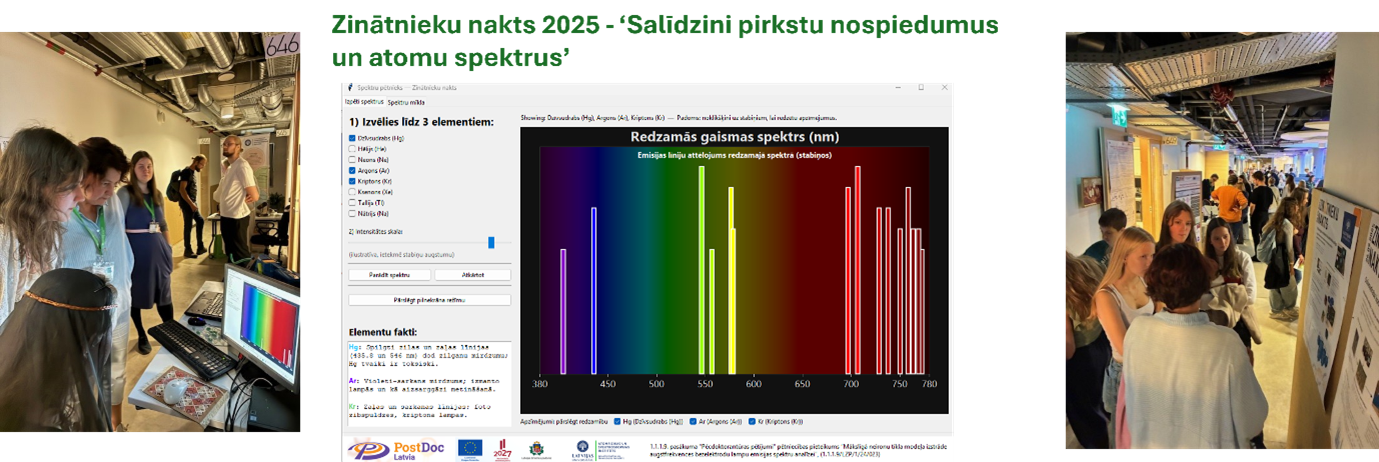
Third reporting period (01.03.2026.–31.08.2026.)
During the reporting period, work continued on the development and optimization of the artificial neural network architecture, as well as on spectral-data preparation and processing automation. Methods and software tools for processing experimental and synthetic spectra were further improved, and machine-learning approaches for spectral-line recognition continued to be tested. Research results from the reporting period were presented at two international scientific conferences.
Conferences and publications
• 31.Symposium on Plasma Physics and Technology (SPPT 2026) – Czech Republic. Presentation title: “Machine Learning Based Elemental Recognition in Discharge Lamp Spectra for Low-Temperature Plasma Diagnostics”. (Abstract: Plasma Physics and Technology, Vol. 13, No. 2 (2026): https://ojs.cvut.cz/ojs/index.php/PPT/issue/view/936.)
• 2026 IEEE International Conference on Plasma Science (ICOPS 2026) – USA. Presentation title: “Structured Line-Based Representations of Emission Spectra for Diagnostics of Low-Temperature Plasmas”. The conference contribution was published in the IEEE ICOPS 2026 Proceedings (ISBN: 979-8-3315-8136-7; Online ISSN: 2576-7208). The abstract is also available in the ICOPS 2026 conference programme: https://icops2026.exordo.com/programme/presentation/359.
Project publicity and public engagement
15.08.2026. As part of the Latvian Council of Science activity “Zinātnes burbulis” (“Science Bubble”) at the science festival “Mērsraga ābols”, together with University of Latvia researcher Anda Ābola, the activity “Gaismas slepenā valoda” (“The Secret Language of Light”) was carried out. Festival visitors could learn about light spectra, plasma lamps, and the principles of spectrometry.
The project topic was explained in a popular-science format, demonstrating how artificial intelligence and machine learning can be used for spectral-line recognition and to automate time-consuming data-analysis processes. The activities were intended for a broad audience, including families with children.
More information: Discover science together with the Latvian Council of Science at the “Mērsraga ābols” festival (in Latvian)