
 CONFERENCE
Project title: Transforming chronic wound care with targeted MXene-based antibacterial and regenerative technologies (MX-WOUND)
Grant agreement ID: 101299634; https://cordis.europa.eu/project/id/101299634
Implementation time: 01.09.2026-31.08.2030
Total project funding: 1 588 700 EUR
University of Latvia funding: 210 420 EUR
Research coordinator: Dr. Maksym Pogorielov (Advanced Biomaterials and Biophysics Laboratory)
Administrative manager: Inga Šīrante, FST project manager
Project Consortium:
Coordinator - Latvijas Universitāte
Beneficiaries (8)
- Uniwersytet im. Adama Mickiewicza w Poznaniu, Poland
- Fraunhofer-Gesellschaft zur Förderung der angewandten Forschung e.V., Germany
- Vilniaus universitetas, Lithuania
- Instytut Immunologii i Terapii Doświadczalnej im. Ludwika Hirszfelda Polskiej Akademii Nauk, Poland
- Сумський державний університет - Sumy State University, Ukraine
- Центр Материаловедения - Materials Research Centre, Ukraine
- MB SensoGrafa, Lithuania
- nanoSPACE Technology s.r.o., Czechia
Other Partners (1)
- Worcester Polytechnic Institute, United States
Project Objective: The MX-WOUND project aims to revolutionize chronic wound care by developing a first-of-its-kind multimodal antibacterial and regenerative platform powered by MXene nanotechnology. Conventional treatments are increasingly ineffective due to multidrug-resistant infections and insufficient regenerative support. MX-WOUND addresses these challenges by uniting targeted antibacterial therapy, photothermal modulation, and regenerative stimulation into a single, clinically translatable solution.
MXenes, a cutting-edge class of 2D transition metal carbides and nitrides, will be polydopamine-coated and conjugated with MRSA-specific antibodies to ensure highly selective bacterial targeting. Combined with near-infrared light-triggered photothermal therapy, this approach enables rapid pathogen eradication with minimal damage to surrounding tissues. In parallel, electrospun and hybrid-spun nanofibrous scaffolds will be engineered to deliver mesenchymal stem cell-derived secretome, promoting angiogenesis, immune modulation, and tissue repair to accelerate wound closure.
MX-WOUND unites leading academic, clinical, and industrial partners from Europe, Ukraine, and the USA in a highly interdisciplinary network. The project follows a rigorous translational pipeline—MXene synthesis and functionalization, scaffold fabrication, in vitro validation, and preclinical in vivo testing—ensuring robustness, scalability, and clinical relevance.
Beyond scientific innovation, MX-WOUND will train a new generation of researchers through cross-sectoral secondments, industry placements, and mentoring. By integrating nanotechnology, precision photothermal therapy, and regenerative medicine, MX-WOUND will deliver a transformative, antibiotic-free therapy for chronic wounds, improve patient outcomes, and help combat the global threat of antimicrobial resistance.
See project www for more info: https://www.mx-wound.eu/
Project publicity
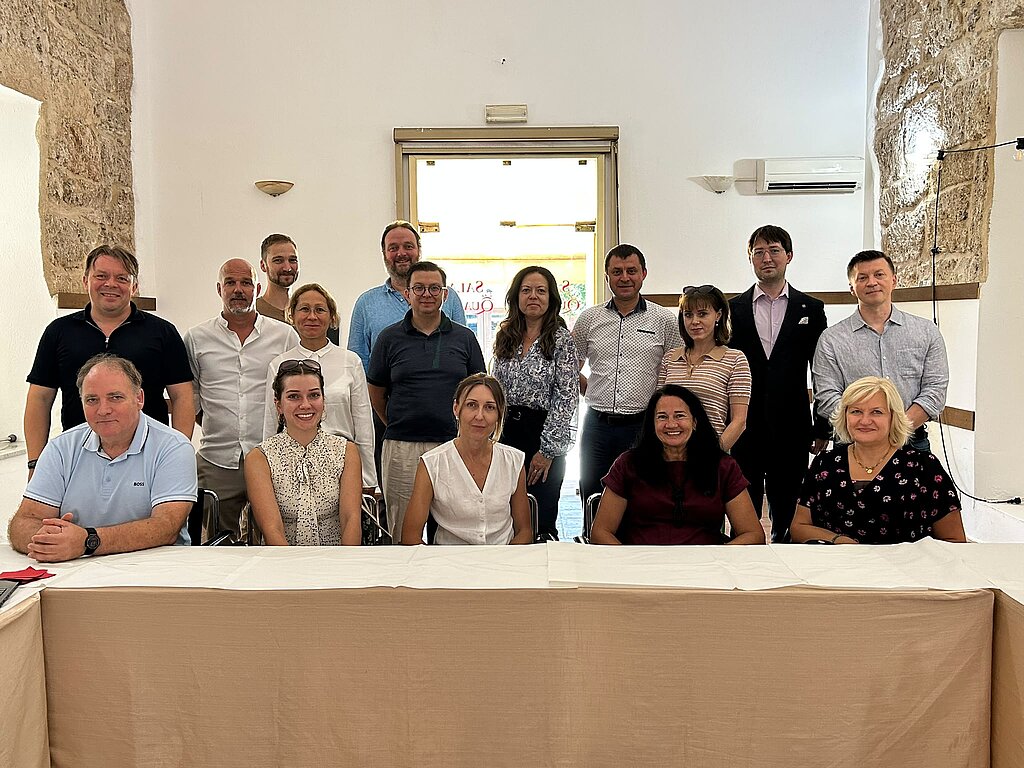
Researchers from the University of Latvia participated in an intensive week of scientific meetings and conference activities in Alghero, Sardinia, focused on advanced materials and biomedical applications of MXenes.
The week began with the kick-off meeting of the new MSCA Staff Exchanges MX-WOUND project, coordinated by the University of Latvia. Representatives of all nine project partners discussed the research programme, planned secondments and future activities aimed at developing innovative MXene-based approaches for wound treatment.